This is about public waters, not commercial complexes
Holiday lake complexes that sell overnight carp sessions build bivvy access into their offer and tell you the rules directly. Public waters don’t — an AAPPMA-controlled lake or river stretch, an SPW canal in Belgium, or a federation water in the Netherlands comes with no leaflet. The rule sits in national law or local byelaw, and it is genuinely different in each country.
Rather than working through the mechanisms below for every trip, every venue on the PiscaMaps map already shows its confirmed bivvy status alongside night fishing rules — check the specific water directly instead of guessing from a national default.
France: the bivouac/camping distinction is the whole mechanism
“Standard bivouac law” isn’t marketing language — it refers to a real legal distinction in French law between bivouac and camping:
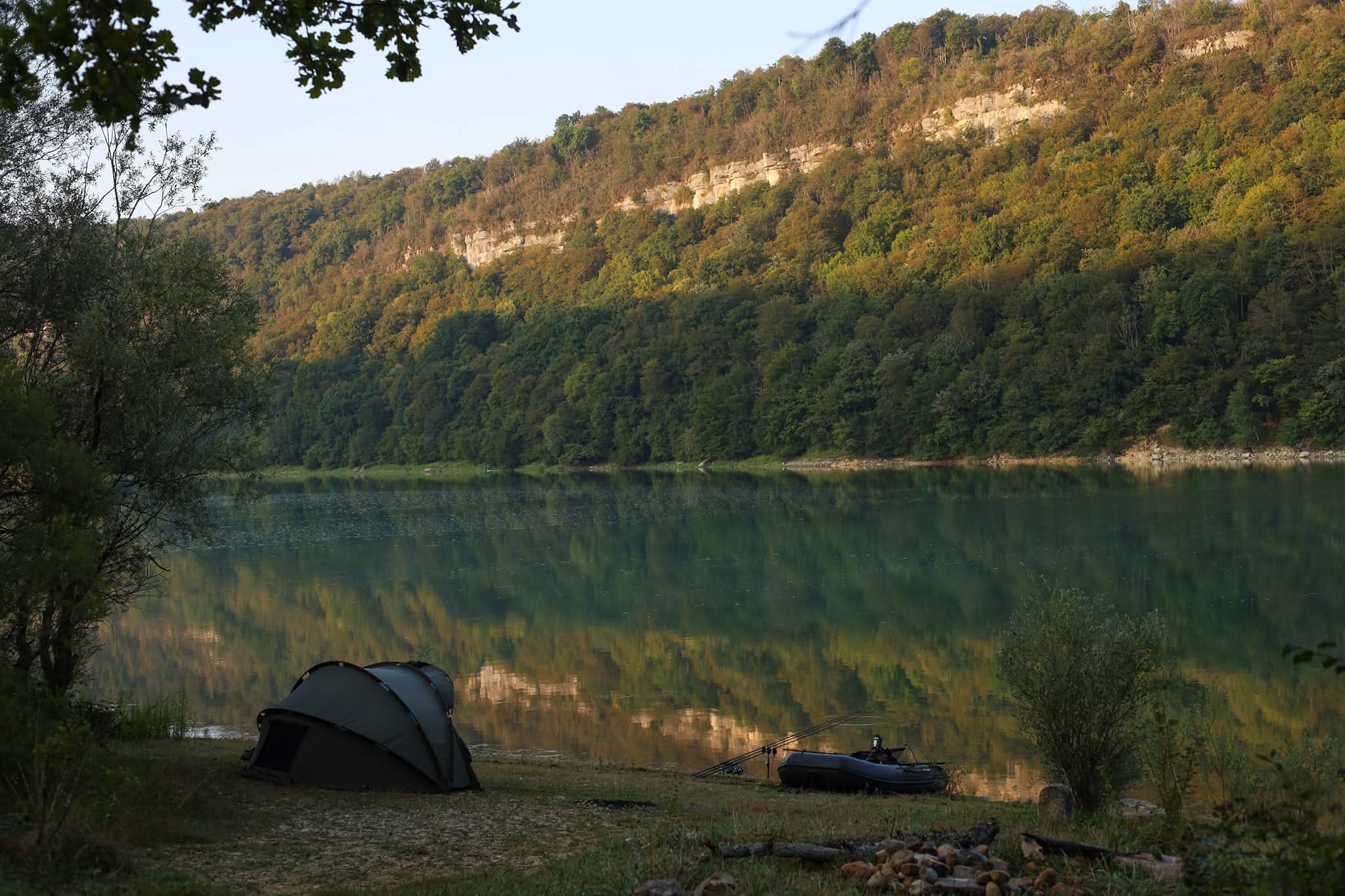
- Bivouac is temporary overnight shelter with no fixed installation — a tent or shelter pitched for the duration of an activity (here, a fishing session) and taken down afterwards.
- Camping implies something more permanent or installed — and is what is actually restricted in protected areas.
Under the Code de l’Environnement, bivouac is generally tolerated overnight in most natural areas except:
- Within 200m of a classified historic monument
- Inside certain protected natural zones (some nature reserves, specific classified sites)
- Anywhere local signage or a departmental order explicitly prohibits it
On a public AAPPMA water, this means the default position is closer to “tolerated for the duration of the session” rather than “banned unless stated otherwise” — but the water’s own règlement intérieur (the AAPPMA’s local rules) or municipal byelaws can still override this, particularly near reservoirs, drinking water sources, or built-up areas.
The reservoir and drinking-water exception is the one most likely to catch out anglers on a public lake near a town. Many popular French carp lakes are reservoir-fed or adjacent to drinking water infrastructure — local rules on these waters often restrict bivouac regardless of the national default position.
Night fishing permission and bivouac permission are separate questions in France. A 2nd category water may permit night fishing by default, but the AAPPMA’s own rules may separately restrict bivouac. Check both when planning an overnight session.
Belgium: no equivalent national tolerance
Belgium doesn’t have a bivouac/camping distinction built into national law the way France does. On public waters managed by SPW or local federations, bivvy permission is set at the water or club level rather than defaulting to a national tolerance.
- There is no “generally permitted unless restricted” starting point to fall back on in Belgium.
- On most publicly managed waters — SPW-managed canals, navigable rivers and federation stretches — bivvy tents are not assumed to be permitted and are subject to the rules of the managing authority or local club.
- Permission (or its absence) is typically part of the specific water’s rules. These are not always published in a place a UK angler can easily find — asking the venue or local club directly is the most reliable approach.
If a Belgian water permits night fishing (Wallonia Permit C waters), that does not automatically mean bivvy is permitted. Night fishing permission and bivouac permission are granted separately in Belgium, just as in France. Confirm both before setting up for an overnight session.
The Netherlands: the most restrictive of the three
This is where the gap between France and the Netherlands is biggest, and where UK anglers most often assume French-style tolerance applies when it doesn’t.
- Bivvy tents and overnight shelters are considerably more restricted on the Dutch public network than in France.
- A VISpas with a night fishing endorsement covers being on the water overnight — it does not automatically cover erecting a shelter. These are separate permissions.
- Where bivvy access is permitted at all on public waters, it tends to be explicitly stated for that specific water rather than assumed.
The practical rule for the Netherlands: treat bivvy and night fishing as entirely separate questions. Having one does not imply the other. Check the specific water’s rules for both before planning an overnight session.
A night fishing endorsement on a Dutch VISpas does not include bivvy permission. Do not assume that because a water is open for night fishing it is also open for shelters. Check per water via the venue or the VISplanner.
What to actually check before a public-water session
- Does the water’s category or classification carry a national default (as with France’s bivouac tolerance), or does permission sit entirely with the local water (Belgium, Netherlands)?
- Is there a reservoir, drinking-water, or protected-zone exception that overrides the general position?
- Does night fishing permission (if any) actually extend to erecting a shelter, or is that a separate question — as it is in both Belgium and the Netherlands?
- Is there on-site signage that overrides what is published online?
Check bivvy rules per venue
Every public water on PiscaMaps shows its confirmed bivvy status directly — alongside night fishing rules, species information and access notes — so you’re checking the specific water, not guessing from a national default.
Open the mapThe takeaway
France is the only one of the three with something close to a general bivouac tolerance baked into national law — and even that has real exceptions around reservoirs, protected zones and local AAPPMA rules. Belgium and the Netherlands don’t have an equivalent default, which means “check the specific public water” isn’t a hedge, it’s the actual rule.
- France — bivouac tolerated by default on most public waters under the Code de l’Environnement, but local rules, reservoir proximity and protected zones can override this. Always check the AAPPMA’s règlement.
- Belgium — no national tolerance. Permission sits with the water or club. On SPW-managed and navigable public waters, bivvy is not assumed to be permitted.
- Netherlands — the most restrictive of the three. Night fishing permission and bivvy permission are entirely separate. Check both per water.