
Unhooking mats — bigger than you think you need
The most common mistake UK anglers make on French public lakes is bringing a mat sized for a 20lb commercial fishery carp. When a 40lb common slides off the cradle because it's too small, you have a problem. On uneven bankside terrain — roots, rocks, slopes — an undersized mat is genuinely dangerous for the fish.
For French public lake fishing the rule is simple: go XL as a minimum. A mat rated to 60lb gives you the margin for the fish you weren't expecting, and the extra surface area makes handling much easier when you're alone. Standard flat mats are fine for small fish, but for any serious session a walled cradle is the better choice — the padded sides keep an active fish contained and prevent it rolling off while you're sorting the rig or reaching for your camera.
The main brands worth considering are Korda (Basix and Compac ranges — excellent value and quality), Trakker (Sanctuary Cradle — 6 adjustable legs, rotating mud feet, PVC cover that retains water over the fish), and Fox (Carpmaster range — walled mats with quick-zip sides). For a proper week-long session on a big French venue the Trakker Sanctuary Cradle XL is hard to beat — it doubles as a weighing station, has a large storage pocket for your care kit, and keeps the fish completely off the ground on uneven banks.
Key things to look for: 70mm+ foam padding (not the thin entry-level stuff), a waterproof fish-friendly outer that won't strip slime when wet, and walled sides high enough to contain a lively fish. If you're on a venue with uneven or sloped banks, a cradle with height-adjustable legs keeps the fish level and takes strain off your back.
Always wet the mat before the fish touches it. A dry foam surface — even a high-quality one — will strip protective slime from the fish. Keep a bucket of lake water next to the mat at all times and soak it before every fish. This is not optional.
Weigh slings — the right tool for the job
A weigh sling does two things: it lets you weigh the fish safely, and it acts as a transfer vehicle between the water and your unhooking mat. A good sling has large drainage holes so water escapes quickly when you lift the fish, rigid bars at the top to maintain shape and allow even balance on the scales hook, and zips at both ends to prevent the fish sliding out during transit.
Wet the sling thoroughly before use — same principle as the mat. Zero a set of digital scales with the wet sling attached before you put the fish in, and you get a clean weight reading without having to do the mental arithmetic.
One important distinction: a weigh sling is not a retention sling. Standard weigh slings are not designed to hold a fish in water for an extended period. If you need to retain a fish briefly for photos or recovery, you need a dedicated retention sling (more on that below).
Retention — the French public water rule you must know
Retaining carp in sacks or retention slings on French public waters is illegal. Article L.436-5 of the French Environmental Code prohibits the retention of fish in keepnets or sacks on most public waters. This applies to carp specifically and is actively enforced by the ONEMA (Office National de l'Eau et des Milieux Aquatiques). The penalty is a fine and potential confiscation of equipment. Return the fish immediately after unhooking, weighing and photography. Do not retain it overnight for dawn light photos.
This is one of the most important rules for UK anglers to understand before they arrive. The retention culture that exists on many UK syndicate and day ticket waters simply does not apply to French public fishing. A retention sling such as the Trakker Sanctuary is not illegal to bring — it's entirely legitimate to support a fish in the margins in a floated sling for a short period while it recovers before release. But leaving a carp in a sack overnight for dawn light photos is a criminal offence under French law. The rule of thumb: once the fish is kicking strongly and orientating normally, release it.
If a fish needs time to recover after being caught, hold it gently in the water in your landing net or cradle. Once it kicks strongly and orientates normally, release it. This is what the AAPPMA and ONEMA expect, and it's the right approach regardless of legality.
Weighing accurately — scales and technique
On a large French public lake you may have waited years for a fish like the one on your mat. Getting an accurate weight matters. A few things that affect accuracy:
- Zero with a wet sling — always tare the scales with the wet, empty sling attached before you put the fish in. A dry sling adds 200-400g of false weight.
- Digital scales with a large dial — for fish over 20kg, a cheap set of postal scales simply doesn't have the precision or range. A 60kg-rated set of digital carp scales reads to 100g increments and won't bottleneck your accuracy.
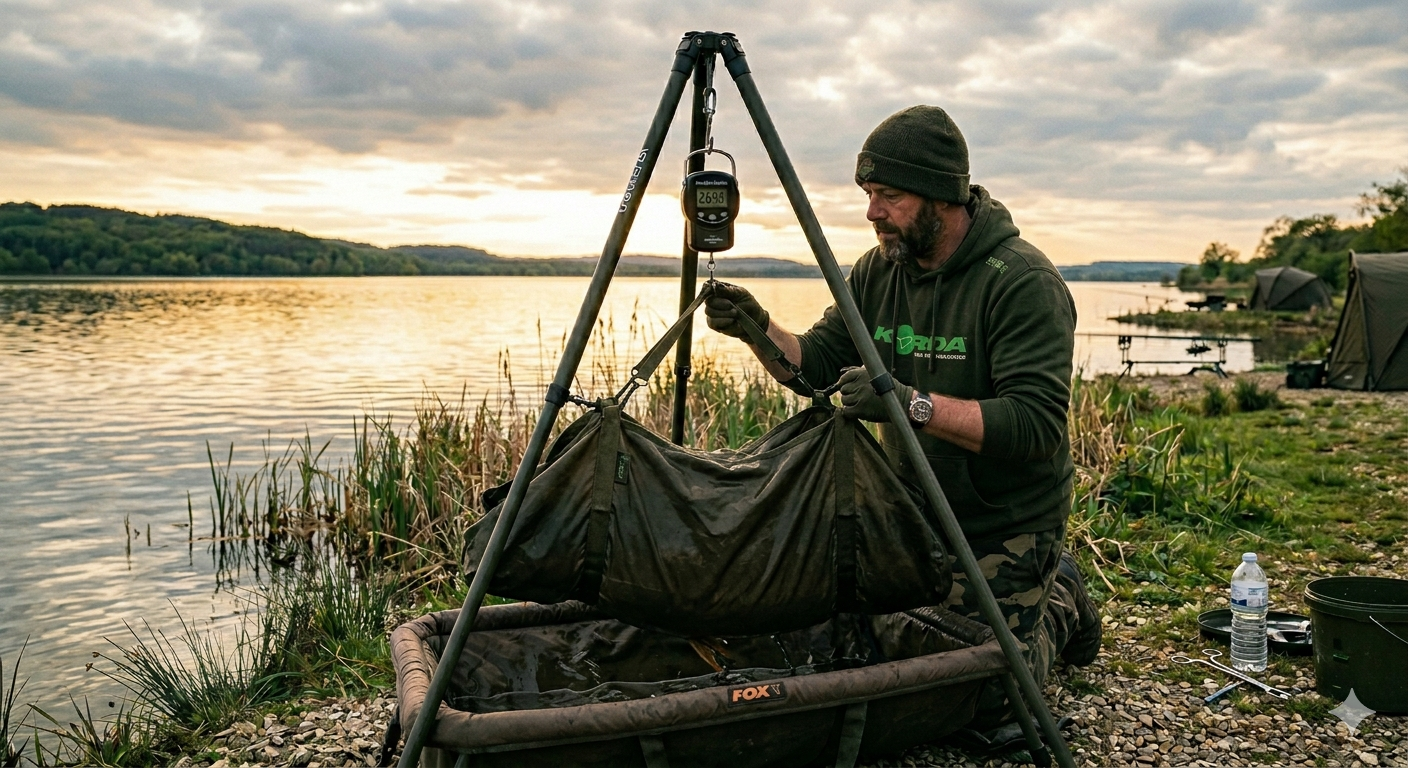
- Weigh tripod for heavy fish — trying to hold a 30kg+ fish steady on a handheld scale while solo is genuinely difficult and stressful for the fish. A weigh tripod lets you hang the sling, take a steady reading and photograph the scales without rushing.
- Weigh in shade — direct sun heats the fish and stresses it during the weighing process. Keep operations in shade wherever possible, work quickly, and have water ready to pour over the fish.
Wound treatment — propolis and why it matters
Hook holds, scale loss, mouth damage, fin tears — any wound on a carp in warm French summer water is a potential infection site. French public lakes are not always pristinely managed, and the bacterial load in a silty reservoir can be significant. Treating wounds before release is not optional if you're serious about fish care.
Propolis is the standard treatment — a natural product derived from bees with genuine antibiotic and antimicrobial properties. On contact with water it becomes insoluble, forming a waxy seal over the wound that prevents bacteria entering while the fish heals. Apply it to the hook hold, any scale loss, and any other visible wound. A small amount goes a long way — the dropper nozzle lets you apply it precisely. Splash a little water on once applied to set the seal before the fish goes back.
An ulcer swab (antiseptic cleaning solution) should be used first on any open wound or existing ulcer — clean the area, then seal with propolis. The Korda Carp Care Kit contains both in a compact zipped pouch, which is the simplest way to make sure you always have both on you.
Handling big catfish safely
If you're fishing a French public lake that holds catfish — and many of the larger venues do — you need to be prepared. A metre-long wels catfish is a fundamentally different challenge to a carp. They are powerful, writhe continuously, have no scales to protect them, and their spines can inflict a painful puncture wound if you're not careful.
The risks
Catfish have serrated pectoral fin spines that can lock in the extended position and cause a nasty wound if the fish thrashes and drives the spine into your hand. The dorsal spine is shorter but equally sharp. These aren't trivially small — on a large catfish the pectoral spines can be several centimetres long and as thick as a pencil.
Their skin is also covered in a protective mucus that can be an irritant to eyes and open cuts. Keep your hands away from your face while handling them and wash thoroughly afterwards.
The right approach
- Wear a thick glove on your leading hand — a sturdy gardening glove or dedicated fish-handling glove gives you enough grip and puncture resistance to control the fish safely. One glove on the hand that goes under the body; the other hand free for unhooking.
- Use long forceps for unhooking — catfish have large, toothy mouths. Long-nosed forceps (20cm+) let you reach the hook without putting your fingers anywhere near the teeth or the back of the throat. Don't use your fingers.
- Support the belly, not the jaw — catfish should be cradled along the body with one hand under the pectoral area. Lifting by the jaw stresses the spine. They're long fish — you may need a second person for photography on anything over a metre.
- Keep them wet at all times — catfish are particularly sensitive to drying out. Their skinless body loses moisture fast. Keep pouring water over them throughout handling.
- Use an oversized mat — a standard carp cradle is fine for small catfish, but a big fish will hang over the edges. Lay them on a large flat mat for photography and keep handling time absolute minimum.
- No retention — same rule as carp. Release immediately after photographs.
Never attempt to unhook a large catfish by hand without forceps. Their teeth aren't shark-like but the backwards-facing rows cause friction burns if your hand slides. Combined with a thrashing 20kg fish, you will get hurt. Carry dedicated long-nosed forceps and use them every time.
General fish care principles for French public water
A few habits that make a real difference on any public water session:
- Set up the mat before you start fishing — not when the fish is on the bank. Mat out, bucket of water ready, forceps and carp care kit to hand. Every second spent fetching equipment is a second the fish is under unnecessary stress.
- Unhook in the net — for large or lively fish, unhooking in the landing net in the margins while the fish is still in the water is far less stressful than bringing it onto the bank. Reach in, remove the hook, then lift it to the mat for treatment and photographs.
- Work in shade — direct summer sun on a French bank is brutal for fish. Always position your mat in shade if any is available. In open swims, use your unhooking mat's built-in cover flap or drape a wet cloth over the fish.
- Hold the fish in the margins to recover — after weighing and photography, support the fish gently in the water until it is upright, orientated and kicking strongly under its own power. Don't simply drop it and walk away. On a warm day this can take several minutes for a large fish.
- Use your dry mat bag to transport the wet mat — a wet unhooking mat in the boot of your car will grow mould and smell appalling within days. Always bring a bag to contain it, and dry it out when you get home.
Check fish care rules before you travel
Retention rules, cat fishing permissions and night fishing regulations vary by venue on French public water. PiscaMaps lists the key rules for 2,800+ lakes and rivers so you can check before you leave the UK.
Open the MapFish care kit checklist
- XL cradle or unhooking mat — walled, 70mm foam minimum, rated to 60lb+
- Weigh sling — with rigid bars and end zips; wet before use, tare scales with it
- Scales — Reuben Heaton analogue or quality digital; 60kg+ range for large public lake fish
- Fox weighing tripod — essential for solo sessions; hang the sling, read the scales, photograph without rushing
- Propolis — apply to all hook holds, scale loss and wounds before release
- Ulcer swab / antiseptic — clean open wounds before treating with propolis
- Water bucket — keep mat wet; pour over fish during handling and photography
- Long-nosed forceps (20cm+) — essential for safe catfish unhooking
- Thick glove — one glove for catfish handling to protect against pectoral spines
- Mat carry bag — contain the wet mat for transport home
- No retention sacks — carp retention on French public water is illegal; release immediately
ℹ️ This post contains affiliate links to Amazon. If you buy through them we earn a small commission at no extra cost to you.