
The battery — lead acid vs lithium
The old standard for a French carp trip was a 110Ah sealed lead-acid leisure battery in a battery box. It works, and thousands of anglers have run successful sessions on them. But lithium iron phosphate (LiFePO4) has changed the conversation completely.
Why lithium makes sense for fishing
A 100Ah LiFePO4 battery delivers close to 100Ah of usable capacity — you can safely discharge to 80-90% without damaging the cells. The same-rated lead-acid battery should only be discharged to around 50%, giving you a true usable capacity of roughly 55Ah. So a 100Ah lithium battery is roughly equivalent to a 200Ah lead-acid in terms of usable power.
Add in the weight difference — a 100Ah lithium weighs around 10kg vs 26kg for lead-acid — and the choice becomes straightforward for anyone walking a distance to their swim or carrying kit across a silty bank.
The main objection is cost. Lithium batteries are significantly more expensive upfront. But they're rated for 3,000-5,000 charge cycles versus 300-500 for lead-acid. Over five years of regular use, the cost per cycle works out comparable or cheaper.
The battery box — organised power distribution
Running a bare battery in your bivvy is asking for trouble — exposed terminals, no fusing, nowhere to plug in multiple devices. A purpose-built battery box solves all of this in one unit: the battery sits securely inside, and the lid gives you USB outputs, a 12V socket, a circuit breaker and an LED charge indicator.
The Bison battery box has been the standard choice for UK carp anglers for years for good reason — it's well-made, practical and designed specifically for the job. The V2 Deluxe version adds multiple USB outputs, which matters when you're charging phones, bite alarms and headlamps simultaneously.
How much battery capacity do you actually need?
The honest answer is: it depends on what you're running and for how long. Here's a rough consumption estimate for a typical 5-night session without solar top-up:
| Device | Approx. draw | Daily Ah | 5 nights |
|---|---|---|---|
| Echo sounder (6 hrs/day) | 0.5A | 3Ah | 15Ah |
| Cool box (running 24hrs) | 3–5A | 72–120Ah | 360–600Ah |
| Smartphone charging (×2) | 1A | 8Ah | 40Ah |
| Bivvy light (4 hrs/night) | 0.5A | 2Ah | 10Ah |
| Electric motor (2 hrs/day) | 25A | 50Ah | 250Ah |
| Total (without motor) | — | ~85–130Ah | ~425–665Ah |
The cool box dominates the numbers. A quality 12V compressor cool box on continuous operation is the biggest single drain on your setup by a significant margin. This is why most experienced anglers either run a passive insulated box or invest in a solar panel to offset cool box consumption.
For a 5-night session without a 12V cool box or electric motor: a single 100Ah lithium will comfortably cover echo sounder, phone charging and bivvy light with margin to spare. Add a cool box or motor and you need solar top-up or a second battery.
Solar panels — free power from a French summer
France in summer means long days and reliable sunshine — exactly what a solar panel needs. A 100W panel on a south-facing setup will typically produce 40-60Ah on a clear day, which is enough to offset most of your daily consumption and keep your battery topped up across a week-long session.
The practical consideration is portability. A rigid panel is more efficient but awkward to transport and set up on an uneven bank. Foldable or semi-flexible panels are more practical for fishing, though slightly less efficient per watt. A 100W foldable panel is the standard starting point — enough to cover light consumption, or to extend a 100Ah battery across a longer trip when combined with sensible power management.
You'll need a solar charge controller between the panel and battery — ideally a MPPT controller rather than a PWM, as MPPT extracts 20-30% more usable power from the same panel. Renogy make reliable, affordable MPPT controllers that pair well with their own batteries and are widely used by UK anglers in France.
Powering your echo sounder
Most dedicated carp anglers use their echo sounder from the boat — a couple of hours at the start of the session mapping features, dropping spot markers and identifying where fish are holding. The Lowrance Hook Reveal range draws around 0.5A at typical brightness, meaning a full day of active use costs roughly 5-6Ah. From a 100Ah battery, that's almost nothing.
The practical consideration is the 12V connection. Your echo sounder will either have alligator clips or a cigarette lighter plug. Use the 12V socket on your Bison box, or connect directly to the battery terminals with a fused lead. Never run it through a cheap unprotected connection — a short circuit on a lithium battery is a serious fire risk.
For boat-mounted use, some anglers prefer a dedicated smaller battery for the echo sounder — a 20Ah lithium trolling battery is more than enough for echo sounder use and keeps your main battery isolated for camp power.
Keeping food cold — the cool box dilemma
Food safety on a week-long summer session in France is a genuine concern. Temperatures regularly hit 30°C and above, and your food and bait need to stay cold for days without a shop visit. You have two fundamentally different approaches.
Passive cool boxes — ice-based
A quality passive cool box — properly pre-chilled, packed with ice and kept in the shade — will hold temperature for 3-5 days in typical French summer conditions. The Yeti Tundra and Icey-Tek ranges are the benchmark for ice retention, with rotomoulded walls that genuinely outperform cheaper alternatives. The downside: you need to source ice every 3-4 days, which means a trip to the nearest town.
12V compressor cool boxes — electric
A 12V compressor cool box runs like a small fridge — proper compressor cooling, not Peltier — and will maintain temperature indefinitely as long as it has power. The Totalcool range uses evaporative cooling technology rather than a compressor, making it far more energy efficient (around 45W vs 60-80W for a compressor) while still delivering genuine cooling in French summer temperatures.
If you go down the 12V cool box route, budget for a solar panel to offset the continuous power draw. Running a compressor cool box on a single 100Ah battery without solar will drain it in roughly 24-48 hours depending on ambient temperature and how often it's opened.
Don't run a 12V cool box directly from your main fishing battery without a solar panel to compensate. You will run out of power mid-session, your food will spoil and you'll have no power for your echo sounder or phone. Either run a dedicated second battery for the cool box or invest in solar.
Phone & device charging
Your phone is critical on a French public lake session — PiscaMaps for venue details, Google Maps for getting there, WhatsApp to let people know you're safe, and the camera for the fish of a lifetime. Running it down to zero on day two is not an option.
The 5V USB outputs on your Bison box will charge phones, bite alarm receivers and headlamps. For faster charging, a 12V to USB-C converter plugged into the 12V socket gives you 18W-65W fast charging rather than the 2A (10W) USB output on the Bison.
A simple rule of thumb: every smartphone charge from empty costs roughly 0.3-0.5Ah from a 12V battery. Charging twice a day for a week costs around 5-7Ah — barely noticeable on a 100Ah battery.
Portable power stations — the alternative approach
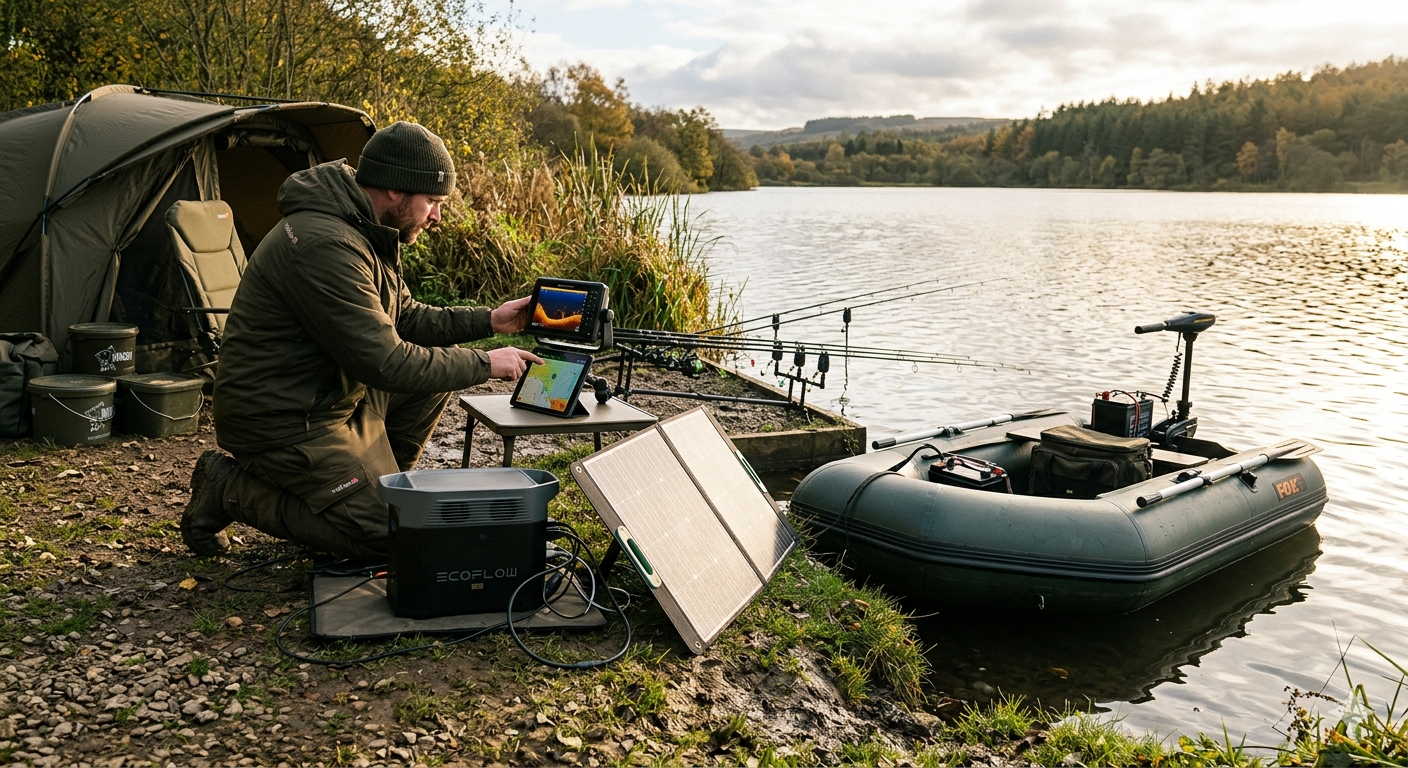
The traditional 12V leisure battery in a Bison box is the established carp fishing setup — and it works well. But a newer generation of portable power stations from brands like EcoFlow and Jackery offers a genuinely compelling alternative, particularly for anglers who want a simpler, more plug-and-play solution.
The key difference is that these units are all-in-one: the battery, inverter, circuit breaker, USB ports, 12V output and display are all built in. There's no need to wire up a Bison box or buy a separate charge controller for solar. You plug in, turn on, and your devices run. They also have the significant advantage of AC mains output — meaning you can charge devices that only take a standard plug.
The trade-off is capacity per pound of cost. A 245Wh EcoFlow River 3 contains significantly less usable energy than a 100Ah lithium battery (roughly 1,280Wh at 12V). For a 5-7 night session with a cool box, you'd need either a larger unit or to pair it with solar. But for shorter sessions, or anglers who don't run a 12V cool box, they're an excellent choice.
Which approach suits you? For 1–3 night sessions without a 12V cool box: a portable power station is simpler and perfectly adequate. For 5–7 night sessions running a cool box, echo sounder and electric motor: a 100Ah lithium in a Bison box with a solar panel gives better capacity per pound spent.
Power setup checklist — a week on a French public lake
- 100Ah LiFePO4 battery — Renogy with Bluetooth monitoring
- Bison battery box — V2 Deluxe with multiple USB and 12V socket
- 100W solar panel — foldable, with MPPT controller and cables
- Echo sounder — Lowrance Hook Reveal 7 with SplitShot transducer
- Cool box — Yeti Roadie (passive) or Totalcool (12V) depending on session length
- 12V to USB-C fast charger — for phones and devices
- Fused leads — 60A fuse between battery and any high-draw device
- Battery charger — lithium-compatible, for topping up before you leave the UK
Check boat and night fishing rules before you travel
PiscaMaps lists boat permissions, night fishing rules and local AAPPMA contacts for 2,800+ French public lakes — so you know exactly what you're heading to before you pack the car.
Open the Mapℹ️ This post contains affiliate links to Amazon. If you buy through them we earn a small commission at no extra cost to you.