Rods — why test curve matters more on public water
On a commercial fishery you can often get away with a 2.75lb rod at 80 metres. On a public lake, that same scenario might require a 120-metre cast into deep water with a 4oz lead, plus the backbone to bully a heavily built wild common away from a silty margin. The demands are simply different.
For most French public lake fishing, 3.25lb to 3.75lb test curve at 12ft/13ft is the working standard. It gives you the range to reach open-water spots, the power to set a hook at distance and enough reserve to handle fish that haven't been played out on a commercial circuit. If you're regularly using a bait boat or boat-mounting your rigs, you can drop slightly in test curve since casting distance becomes less critical — but don't go below 3lb.
Abbreviated handles are worth considering for boat fishing and baiting from a dinghy — the shortened butt makes manouvering far easier in a small inflatable.
Don't bring commercial-water tactics to public lakes. Floaters, short-range stalking gear, light hooklinks and tiny hooks are counterproductive when you're targeting unfished wild fish at range in deep water. Pack for the venue you're actually fishing.
Big pit reels — the case for a 14000-size spool
A big pit reel isn't just a marketing term. The 45mm spool stroke and extended line capacity of a 14000-size reel genuinely transforms distance casting — the reduced line friction on a larger diameter spool means you can add 15-20 metres to the same cast versus a standard 6000 or 8000 size. On a 1,000-hectare lake where the fish may be holding at 130 metres, that matters.
The two names that dominate this category for good reason are Shimano and Daiwa. Both have refined big-pit mechanics over decades of development and their flagship models are built to last years of hard use on continental venues.
Mainline — mono, braid or both?
Most experienced public lake anglers run monofilament mainline as a default — 0.35mm to 0.40mm breaking around 15-18lb. It has natural stretch that cushions the initial run of a big fish at range, it's forgiving on the knot, and it sinks well on weedy venues. Load 300-400m of quality mono and you have enough for virtually any scenario.
The case for braided mainline becomes compelling when you're fishing at extreme range (120m+) on relatively clean lake beds, or where instant bite indication is critical. Braid has zero stretch, so a run at 130 metres feels like one at 30 metres on mono. The tradeoff is that you lose the buffer in the fight — use a long fluorocarbon or mono shock leader, and make sure your clutch is set conservatively.
Many anglers run one rod on braid for range work and two on mono — a pragmatic compromise that gives you options without committing the entire setup.
Check the French regulations on braid. Some departments and individual lakes prohibit braided mainline entirely — it's listed in the local arrêté préfectoral. Always check with the AAPPMA before fishing. This is one of the rules PiscaMaps members can check per venue before they travel.
Hooks — bigger than you think you need
Wild French carp have large, tough mouths. A size 6 hook that holds reliably on a pressured UK water can roll out of a big common's mouth at range on a public lake. Size 4 to size 2 is the standard for public lake work, with wide-gape or longshank patterns preferred for fishing over silt or weed.
Chemically sharpened, forged hooks are non-negotiable. Check the point on every session — lake beds with gravel, flint and debris will blunt a hook faster than you expect, and a dull point on a 120-metre run often means a lost fish.
Coated hooklinks in 25-35lb breaking strain give you the stiffness to kick the hook away from the lead and the strength to absorb the shock of a big take at range without nicking.
Leads — going much heavier than feels comfortable
Many anglers visiting French public lakes for the first time are surprised by how heavy a lead they need. 4oz to 5oz for bank fishing — and if you're placing rigs from a boat, 6oz to 8oz gripper-style leads become a genuine option.
Gripper leads — with their moulded fins or wire grips — are designed to dig in and hold position rather than roll with any current or tow. On large open-water venues where undertow and wind drift can move a standard lead several metres from where you placed it, a gripper anchors the rig in place and maintains the presentation you worked to set up from the boat.
The heavier lead also helps with hooking at range — a bigger mass creates more resistance on the take, driving the hook home before the fish realises what's happened. On a fish that's never encountered terminal tackle, that first fraction of a second matters.
Build your lead selection around two categories for a French trip: 4–5oz distance leads for long-range casting into wind, and 6–8oz gripper leads for boat-placed rigs where you need the rig to stay exactly where you put it. Always use lead clips — on an 8oz lead, the ability to eject the lead can be the difference between landing the fish and a break-off.
Snag avoidance — protecting both fish and tackle
Public lake fish don't know the rules about swimming away from snags. A large French common in a shallow silty bay will head directly for the nearest submerged tree trunk at full speed. Your tackle needs to be able to cope.
The principles of snag fishing on public water:
- Locked-down clutch — fish the clutch tight enough that the fish can't gain line to reach the snag. This requires heavier hooklinks and confidence in your knots.
- Leadcore leaders — a 1-metre leadcore leader pins the first section of line to the lake bed, reducing the chance of the fish kiting around the lead into a snag.
- Lead clip systems — use lead clips rather than inline leads in snaggy conditions so the lead can eject if the line wraps around a branch.
- Line grease the first 10 metres — floatant on the line nearest the rod tip keeps it off the surface and away from debris.
Echo sounders — finding fish on vast public water
On a 500-hectare lake, feature finding is the session. You need to know where the gravel runs are, where the silt starts, where the depth drops, where the fish are actually holding. A quality echo sounder mounted on an inflatable dinghy gives you that information in hours rather than days of observation.
The Lowrance Hook Reveal range has become the go-to choice for UK carp anglers heading to France — reliable, relatively affordable, and with enough features to build a meaningful picture of the lake bed. The 7-inch screen is worth the extra over the 5-inch on larger public waters where you need to read the detail clearly at a glance. Genesis Live lets you build a custom contour map of your venue in real time as you row — invaluable on unfamiliar water where you arrive without any depth information.
Bivvies — shelter for a week on the bank
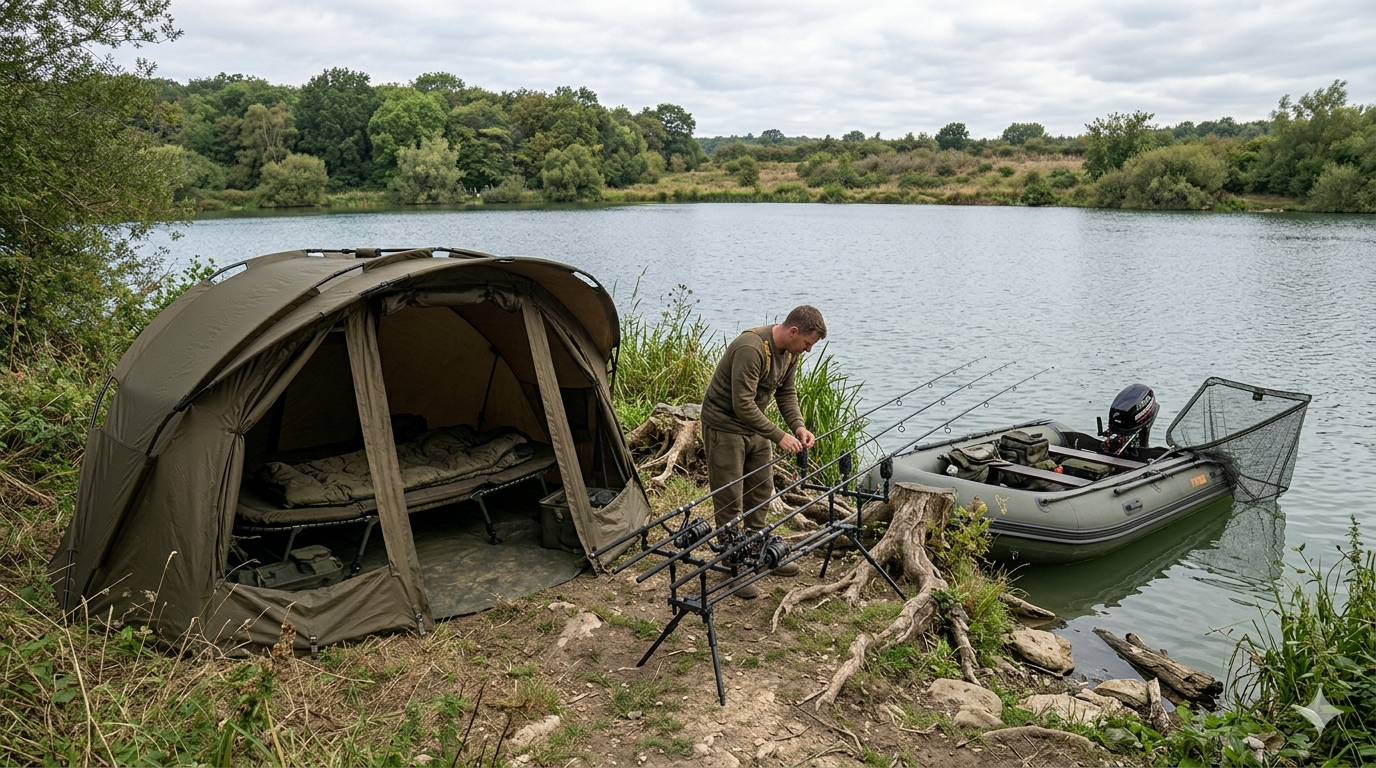
A week on a remote French public lake means living in your bivvy. Unlike a day session on a club water, you need a shelter that handles summer thunderstorms, heat, insects and the occasional early autumn cold snap — all in one setup. This is not the place for a budget brolly.
The key specs for French public lake fishing:
- Hydrostatic head of 10,000mm minimum — French summer storms can be severe. Premium bivvies from Fox (VenTec fabric, 20,000mm), Trakker (Aquatexx, 25,000mm) and Nash are built for exactly this.
- Mozzy mesh panels — essential in summer. Southern France in July has mosquitos that make a UK summer look mild. Make sure your bivvy has mesh panels or a separate mozzy front.
- Single-skin vs twin-skin — a twin-skin or overwrap reduces condensation significantly on longer sessions and adds meaningful insulation for cooler nights.
- Flat-back design — maximises internal space, letting you fit a wider bedchair and keep your tackle organised without everything piling up on the floor.
The Fox Frontier range (ETS boss system, fast setup, flat-back), the Trakker Tempest (unbeatable speed of erection, 25,000mm HH) and the Nash Titan Hide (block-style, incredibly rigid, freestanding) are the three names that dominate the French session market for good reason.
Bedchairs & sleep systems — rest matters on long sessions
A week of night fishing on a public lake means potentially six or seven nights on your bedchair. A bad night's sleep doesn't just make you miserable — it affects your decision-making, your attention to the rods and your ability to deal with the unexpected. This is one area where quality pays back directly in results.
For French public lake sessions the priorities are stability on uneven ground, warmth in cooler nights, and a sleeping bag rated for the season. All six legs should be independently adjustable — silty, uneven swims are common on large reservoirs and you need to dial in the level properly.
Trakker (Levelite and RLX ranges), Fox (Flatliner and R-Series), Nash (Indulgence range) and Solar are the dominant names. For France specifically, the wider models are worth the investment — you'll be on the bedchair for long periods and the extra width makes a real difference over a 5-night session.
A complete sleep system — bedchair, sleeping bag and pillow all matched — is the most practical way to buy if you're starting from scratch. Nash, Fox and Trakker all offer matched systems where the bag is designed to clip directly to the bed, making it easy to fold and carry.
Boats — a brief note on permissions
A boat dramatically expands what's possible on a large public lake — placing rigs precisely, accessing open water spots unreachable from the bank, and covering ground with an echo sounder efficiently. But boat permissions on French public waters vary enormously. Some lakes welcome inflatables with electric motors, others prohibit all craft entirely.
Fox and Nash both produce inflatable fishing boats designed specifically for carp anglers — stable, light and designed to be transported in an estate car. Always check permissions with the local AAPPMA before you travel. Our lake pages on PiscaMaps list boat rules for each venue so you can check before you leave the UK.
Find your next French public lake on PiscaMaps
Filter 2,800+ lakes and rivers by night fishing, boat permissions, species and distance from Calais. Check rules before you travel.
Open the MapPublic lake tackle checklist
- Rods — 3.25lb or 3.5lb TC, 12ft, abbreviated handle
- Reels — 14000-size big pit, loaded with 0.35–0.40mm mono (300m+)
- Braid spool — loaded spare for one rod if fishing extreme range
- Hooks — size 2–4, forged, chemically sharpened; bring plenty
- Leads — 4–5oz distance leads, 6–8oz grippers for boat work; all with lead clips
- Hooklinks — coated braid 25–35lb, fluorocarbon shock leaders
- Snag kit — leadcore leaders, lead clips, heavy-duty swivels
- Echo sounder — Lowrance Hook Reveal 7 with SplitShot transducer or similar
- Bivvy — Fox Frontier, Trakker Tempest or Nash Titan Hide; 10,000mm HH minimum, mozzy mesh essential
- Bedchair & sleeping bag — matched sleep system, 6 independently adjustable legs, season-appropriate bag
- Boat — inflatable dinghy if permitted; check PiscaMaps before travelling
ℹ️ This post contains affiliate links to Amazon. If you buy through them we earn a small commission at no extra cost to you.