
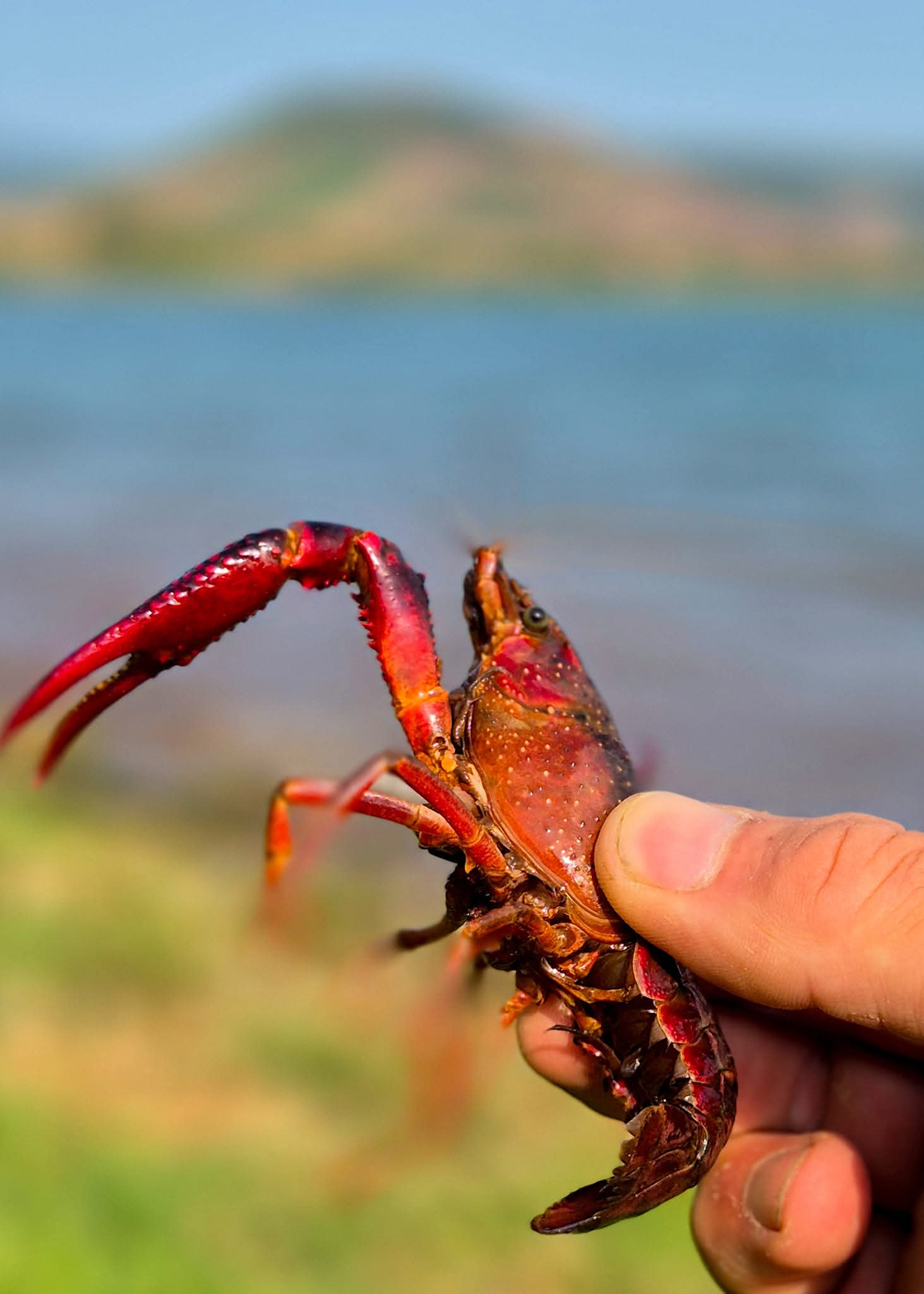
Why French public waters can be crayfish hell
Signal crayfish (Pacifastacus leniusculus) are widespread across France. They thrive in the exact environments that make public lakes so appealing to us as anglers — big, deep barrages and reservoirs with hard rocky margins, clear water, and plenty of natural food. On some venues they are truly prolific, and the warmer the water gets the more active they become. Through the height of summer on certain lakes you can cast out a fresh boilie at dusk and find nothing but a bare hair by midnight.
The carp love eating them, which is one of the reasons fish from these venues grow so big — crayfish are packed with protein. But for us as anglers, they're a pest. A gang of them will dismantle a soft hookbait in a couple of hours, and if your rig is supple or coiled they'll tangle it into a mess while they're at it. On a week-long session where you're covering distance and leaving rods out for long periods, that's a serious problem.
The good news is there are some straightforward things you can do to make your hookbait last properly through the night. We use a combination of approaches — wrapping, bait choice, and rig material — and together they make a big difference.
Korda Supawrap — the first line of defence
The single most effective thing you can do is protect your hookbait with Korda Supawrap. It's a heat-shrink tube that you slide over the boilie, then shrink down tight using steam from a kettle. The clear plastic clings to the bait like a second skin — and critically, it's perforated with tiny holes so the bait still leaks attraction into the water. The crayfish can smell it and are drawn in, but they can't actually get into the bait to start chewing it down.
The method is straightforward. Cut a piece of Supawrap slightly wider than your bait, slide it on, hold it over a steaming kettle for a few seconds and it shrinks down. You can then repeat with a second layer at 90 degrees for extra protection on really bad waters. Use an extenda stop on the hair to make absolutely certain the bait can't be pulled off by a determined cray — they will try.
It comes in three sizes to match whatever hookbait you're using: small (8–12mm), medium (13–22mm), and large (23–32mm). We always carry the medium size as standard for 18–20mm boilies.
Tip: Prep your wrapped baits at home or in the car before you're at the lake — it's much easier with a boiling kettle than trying to do it on the bank. A batch of 20 wrapped hookbaits in a bait box will see you through a week.
Use hard baits — air-dried boilies are your friend
Wrapping helps enormously, but the softer your base bait the less time it will last even with Supawrap on it. Fresh or freezer boilies that are still soft and moist are far more vulnerable than a properly hardened hookbait. The answer is simple: air-dry your hookbaits before you go.
Lay your boilies out on a rack a week or two before the trip and let them dry right out. A properly air-dried 20mm boilie becomes almost rock solid — much harder for a crayfish to break through. It will still leak attractors into the water, especially if you've done a pre-trip soak in a liquid food, but it can easily last 12–24 hours on the hair where a fresh bait might be gone in two or three.
Hardened shelf-life boilies with a high egg content also work well for the same reason. The baking process during rolling creates a tougher skin, and the longer they've been out of the bag the harder they get. Some anglers specifically use boilies that have been left to air for an extended period as dedicated hookbaits, keeping fresher bait for the spod or bag. It's a good habit to get into for any trip where nuisance species are likely.
Tiger nuts — crayfish-proof by nature
Tiger nuts are one of the best hookbaits you can use on a venue with heavy crayfish pressure, and not just because of the carp — it's because crays genuinely struggle to deal with them. A properly prepared tiger nut is dense, tough, and smooth. There's very little for them to grip onto and not much they can do to chew through it. We've left tiger nut hookbaits out for well over 24 hours on venues that strip boilies in a few hours and come back to find them still intact.
They're also an outstanding carp bait in their own right. The natural oils and sugars they release are incredibly attractive, and on waters that see a lot of boilie pressure, tigers can be a real point of difference. Fish them on the hair with a tiger nut stop, or try a combination — a tiger nut with a half-boilie on a multi-hook presentation — to get attraction from both.
If you're taking dry tigers abroad, make sure you prepare them properly — soak for 24–48 hours and then boil or pressure cook until they're swollen and soft enough to drill but still firm. Pre-prepared ready-to-use tigers save the faff and are perfectly valid for a week's trip.
Use stiff hooklink material
It's not just the bait you need to think about — it's the rig itself. When crayfish are active and moving over your spot, a supple braided hooklink will end up tangled into a ball. Crays get their legs caught in the fibres, thrash about trying to free themselves, and leave you with a rig that couldn't catch a fish if it wanted to.
The answer is to switch to a stiff hooklink material for crayfish-heavy situations. Fluorocarbon or stiff monofilament sits straight on the lakebed and doesn't give the crays anything to tangle in. Korda's Boom fluorocarbon is the go-to for this — it's crimpable, virtually invisible on any lakebed, and stiff enough to kick the hookbait well away from the lead and sit there undisturbed. Gardner's Subterfuge Super Stiff is another excellent option if you prefer a knot-tied approach.
You're not sacrificing anything in terms of presentation. A stiff hooklink combi-rig with a fluorocarbon boom section is an outstanding bottom bait presentation regardless of crayfish pressure — it just happens to be extra useful when they're active.
Other things worth doing
Mix particles in with your freebies
A carpet of boilies is a feeding table for crayfish as much as it is for carp. By mixing in particles — corn, hemp, tigers — you slow the crays down. They spend more time rooting around the smaller particles and are less focused on your hookbait. It also creates more disturbance on the spot which can actually help draw carp in.
Recast more frequently
On the very worst venues, sometimes the answer is simply to recast more often rather than leaving rods out all night. If you know crays strip a bait inside two hours, then a fresh cast at 11pm and again at 5am at least gives you some fishing time on each rod. It's not ideal, but on crayfish-nightmare lakes it's a pragmatic call.
Use them against themselves
One trick worth knowing — if crays are active in your margins at night, pick a few up with a landing net or by hand (carefully, they nip) and crush them up. A handful of crushed crayfish mixed into your spod or stick mix creates an incredibly natural food signal on the spot. Carp hoover up crayfish as a major part of their natural diet on these venues, so the oils and scent of a freshly crushed one blended into your freebies can be a real edge. It costs nothing and uses the pest against itself. Just make sure you kill them cleanly first — as noted above, it's illegal to return them to the water in France anyway.
Which French lakes have the worst crayfish?
In our experience, crayfish pressure is generally worst on the larger, older barrages and reservoirs — particularly those with rocky, boulder-strewn margins at depth. Some of the big venues in the Massif Central region, the Auvergne–Rhône-Alpes, and parts of Burgundy can be extremely prolific. Warm summer conditions make everything worse — cray activity ramps up significantly once water temperatures climb through June and July.
Shallower lakes with soft silty beds and lots of aquatic vegetation tend to have less severe crayfish pressure, though nowhere is entirely free of them. The best way to find out before you go is to ask in French angling forums or check recent reports — people who've been on a venue recently will tell you straight away whether crays are an issue.
If you're still looking for your next French public lake, PiscaMaps has over 3,200 lakes, reservoirs, and barrages mapped across France — searchable by region, distance from Calais, night fishing permissions, and more. It's the best way to find a venue that suits what you're after.
Planning your next French fishing trip?
PiscaMaps covers over 96,000 public fishing venues across 17 European countries — lakes, rivers and canals with data on night fishing permissions, boat rules, depth charts and distance from Calais.
Explore the map →This article contains affiliate links to Amazon. If you purchase through these links, PiscaMaps may earn a small commission at no extra cost to you. We only recommend products we have assessed as genuinely useful for bankside use.