
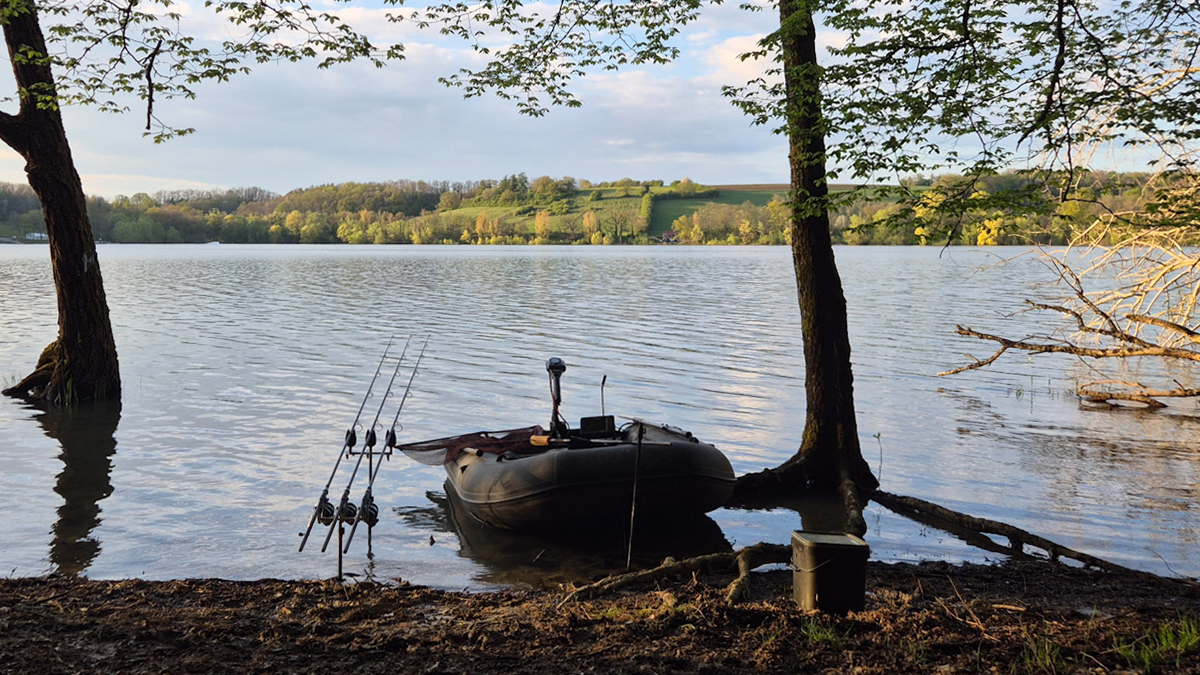
Boat permissions on French public waters
Before anything else — check whether boats are permitted on your chosen venue. On French public waters, boat and motor permissions are controlled by the local AAPPMA and vary considerably from lake to lake. Never assume permission is granted simply because the lake is large enough to warrant a boat.
The typical categories you'll encounter are:
- No boats permitted — bank fishing only, occasionally including float tubes
- Non-motorised boats only — rowing, paddling and electric motors at very low thrust sometimes fall here depending on interpretation
- Electric motors permitted — the most common permission for carp anglers; usually with a thrust limit
- Petrol motors permitted — less common on carp fishing venues; often with a size or speed restriction
PiscaMaps shows boat permissions for every venue in the database. Filter for boat-permitted venues on the map before you start planning, and always cross-reference with the local AAPPMA for the specific rules — thrust limits, no-go zones and restricted areas are set locally and may not be immediately obvious from a general permit.
Bird reserves and restricted zones. Many large French reservoirs have protected areas — bird reserves, spawning bays, dam exclusion zones — where boats are prohibited regardless of your general permit. These are usually marked with buoys or signs on the water. Respect them; enforcement on larger reservoirs can include water police patrols.
Inflatable boats — what works on large French lakes
Inflatable fishing dinghies have become the standard choice for carp anglers on large French public waters. They're compact enough to transport in a van or on a roof rack, durable enough for weeks of use on a big reservoir, and stable enough to work from when baiting, casting or landing fish.
Why Raptor Boats and similar craft
Boats in the Raptor style — heavy-duty PVC inflatables in the 2.2m–3.3m range with a rigid or semi-rigid floor — have become the dominant choice for this style of fishing for good reason. They pack down small, pump up in minutes, handle chop better than lightweight recreational inflatables, and carry the weight of rods, bait, a battery and echo sounder without drama. The rigid aluminium or slatted floor makes them stable enough to stand and move around on, which matters when you're trying to lower a marker float with precision or net a large fish.
Alternatives from manufacturers including Intex, Sevylor and dedicated fishing inflatable brands are widely used, but if you're fishing large, exposed waters regularly, the investment in a quality boat pays back quickly in longevity and confidence on the water.
Size and payload
For solo fishing a 2.2m–2.6m boat is manageable; for two anglers or a heavier load of kit, 2.8m–3.3m is more appropriate. Always check the manufacturer's maximum payload rating and work well within it — a large deep-cycle battery, tackle bags, rods and bait add up quickly. An overloaded inflatable sits low in the water and is significantly less safe in any wind or chop.
Boat safety on large reservoirs
This is the section that matters most. Large French public lakes and reservoirs can be genuinely dangerous. Some of them cover thousands of acres, are exposed to prevailing winds, and generate significant wave height when conditions deteriorate. An inflatable dinghy with an electric motor is not a rough-water vessel.
Always wear a life jacket on the water. No exceptions, no matter how calm it looks when you set off. Conditions on large reservoirs can change within minutes. Cold water incapacitates quickly — if you go in without a life jacket, the chances of self-rescue on a large lake are very low.
Essential safety equipment
- Life jacket or buoyancy aid — a self-inflating life jacket rated to 150N is the minimum for open water use; a buoyancy aid (50N) is inadequate for large exposed reservoirs
- Tether or kill cord — attach to your wrist or life jacket so the motor cuts if you go overboard
- Bailing device — even in calm conditions, a bucket or bailer takes up no space and can be essential
- Paddle or oars — if the motor or battery fails mid-lake, you need a way back; electric motors can stop without warning
- Waterproof phone case or dry bag — phone and essentials should be on your person, not in a tackle bag in the boat
- Whistle or air horn — for signalling if you get into difficulty
- Anchor — essential for holding position while baiting or in any wind; without one you'll drift constantly
Reading the weather
Check the forecast before every trip on the water. Wind speed and direction matter most — a headwind that seemed manageable on the way out becomes a serious problem on the return if the battery is low. A general rule of thumb is to stay off the open water in winds above 15 mph in an inflatable; below that, use your judgement based on the size of the lake, the fetch, and how protected your route is.
On large reservoirs, pay particular attention to the direction of the wind relative to the dam. Wind pushing you towards the dam wall or a steep rocky shore is a dangerous position to be in if the motor stops. Always plan your route so that a motor failure leaves you drifting away from hazards, not towards them.
Tell someone where you're going. Before you launch, let your fishing partner or someone on the bank know your planned route and expected return time. On a remote reservoir this is basic but frequently overlooked.
Launching and landing
Inflate and rig the boat fully on the bank before launching. Check all valves, test the floor firmness, and ensure the motor is correctly mounted and tested before you're afloat. Rocky and uneven shorelines on French reservoirs can damage an inflatable quickly — a landing mat or sheet of tarpaulin under the boat during inflation and launch is worth the effort.
Electric motors
For most carp anglers using an inflatable on a French public lake, an electric motor is the practical and legally straightforward choice. Quiet, emission-free and permitted on the vast majority of boat-friendly venues, they're well matched to the fishing style — slow, deliberate movement between spots, precision positioning over features, and the ability to hold station while working a swim.
Thrust ratings and what they mean
Electric outboard thrust is measured in pounds (lbs). For an inflatable in the 2.2m–3.3m range carrying a typical fishing load, a motor in the 40–55 lbs thrust range is the practical sweet spot — enough to push against moderate wind and chop without draining the battery in an hour. Motors below 30 lbs may struggle on open water; anything above 65 lbs is overkill for most inflatable fishing applications and will drain batteries faster.
Some AAPPMA set a maximum thrust limit for their venue — commonly 30 lbs or 55 lbs. Check before you buy or hire. Arriving at a water with a 65 lbs motor when the limit is 30 lbs is an avoidable problem.
| Thrust | Typical application | Approx. battery life (55Ah) |
|---|---|---|
| 20–30 lbs | Small lakes, calm conditions, light loads | 4–6 hours at medium speed |
| 40–55 lbs | Large reservoirs, typical inflatable load | 3–5 hours at medium speed |
| 65–86 lbs | Larger rigid boats, strong wind/current | 2–3 hours at medium speed |
Popular motor choices
The Haswing Protruar range has become the dominant choice among UK carp anglers fishing French public lakes — built in Europe, UK-stocked with a 2-year warranty, and using a brushless motor with Digimax digital controller for significantly better efficiency than traditional trolling motors. The 1HP 12V model is the sweet spot for most inflatables: equivalent thrust to a 2HP petrol without the noise, emissions or maintenance. The Minn Kota Endura range remains a solid alternative, and for anglers wanting maximum efficiency on longer crossings, the Torqeedo Travel series is worth considering at the premium end.
Shaft length
Match the shaft length to your transom height. Most inflatables need a short shaft (around 381mm / 15 inches). A shaft that's too long creates drag; too short and the propeller cavitates in any chop. Check the manufacturer's recommended shaft length for your specific boat.
Batteries — capacity, weight and management
Battery choice and management is where most anglers come unstuck when they first fish from a boat on a large French lake. Running out of power a mile from shore is not just inconvenient — on a big reservoir in a rising wind, it's dangerous.
Battery types
Lead-acid leisure batteries are the traditional choice — cheap, widely available and easy to charge. A 100Ah lead-acid battery will run a 55 lbs motor at medium speed for a reasonable session. The downsides are weight (a 100Ah lead-acid typically weighs 25–28kg) and the fact that you shouldn't discharge below 50% without damaging the battery's lifespan.
AGM (Absorbent Glass Mat) batteries are a sealed, maintenance-free upgrade on standard lead-acid. They handle vibration better, can be used at any angle, and recover better from deeper discharge. Good choice for regular boat use.
Lithium (LiFePO4) batteries are the premium option and increasingly the choice of anglers who fish from a boat regularly. A 100Ah lithium battery typically weighs 10–13kg against 25kg+ for lead-acid, can be safely discharged to near 100% of capacity, charges faster, and lasts significantly longer over its lifespan. The upfront cost is considerably higher, but for heavy use the weight saving alone is worth it in an inflatable where payload matters.
| Battery type | Weight (100Ah) | Usable capacity | Relative cost |
|---|---|---|---|
| Lead-acid | ~26 kg | ~50% (50Ah) | Low |
| AGM | ~28 kg | ~60% (60Ah) | Medium |
| LiFePO4 lithium | ~12 kg | ~95% (95Ah) | High |
Capacity planning
A rough rule: plan your trip assuming you'll use the motor at around 50% throttle for most of the session. At that setting, a 55 lbs motor draws roughly 15–20 amps per hour. A 100Ah lead-acid battery (50Ah usable) gives you around 2.5–3 hours of active motoring. A 100Ah lithium (95Ah usable) gives you closer to 5 hours. Always leave a reserve — aim to return with at least 20% capacity remaining.
If you're making multiple long crossings, consider a second battery or a larger capacity unit. Running flat halfway across a large reservoir is a situation to engineer your way out of before you leave the bank, not when you're on the water.
Charging on a French trip
Most leisure battery chargers work fine on French 230V mains. Take a travel adapter (Type E plug) and a smart charger that won't overcharge — overnight charging at your campsite or gîte is standard practice. If you're bivvying without mains access, a solar panel (40–100W) connected to the battery via a charge controller can provide useful top-up capacity over a long session, though it won't fully recharge a depleted battery in a day.
Echo sounders and fish finders
An echo sounder changes everything on a large, unfamiliar French lake. What might take days of walking the margins and plumbing with a marker float can be mapped in a morning from the boat — drop-offs, gravel bars, submerged channels, sunken trees, plateaus and deep holes all revealed clearly on the screen. For venue reconnaissance on a public water where you can't rely on prior knowledge, it's an invaluable tool.
Types of unit
Traditional transducer-based units such as the Lowrance Hook series, Humminbird Helix or Garmin Striker are the standard choice. Mount the transducer to the transom or use a portable suction mount, and the unit displays depth, bottom hardness and fish arches in real time as you motor around. Most units in the £150–£400 range are more than adequate for lake reconnaissance.
Castable sonar units such as the Deeper Pro+ or Garmin Striker Cast connect to your phone via Wi-Fi or Bluetooth and can be used either mounted on the boat or cast from the bank. From the boat they work well for close-quarters mapping; their range and screen readability are more limited than a dedicated head unit in bright conditions.
Side-imaging and down-imaging units (available on higher-end Humminbird and Lowrance models) provide a photographic-quality image of the lake bed to the sides and below the boat. Excellent for identifying specific features but not necessary for most carp fishing applications — a basic depth/bottom hardness sounder is sufficient for the vast majority of lake mapping tasks.
Reading the display
The two most useful readings for carp fishing are depth and bottom hardness. Most units represent hardness by the thickness or brightness of the bottom return line — a hard, clear line indicates gravel, sand or rock; a thick, soft, double return suggests silt or weed. Combining this with depth builds a picture of where fish are likely to be feeding.
Mark productive features with waypoints as you go. Most units allow you to save GPS positions and build a simple map over a session, which becomes a reference for every subsequent trip to the same venue.
Power your echo sounder separately. Running your echo sounder from the same battery as your motor will drain it faster than expected. A small 12V 7Ah sealed battery dedicated to the sounder adds negligible weight and protects your motor battery reserve.
Using the sounder for bait placement
Once you've identified a feature, use the boat to position your rigs precisely. Motor slowly over the spot, drop a marker float, then reverse out. Lower rigs over the marker by hand from the boat rather than casting — this eliminates the uncertainty of cast presentation and gets your hookbait exactly where you want it. This approach is standard practice among experienced public water boat anglers in France and makes a significant difference to bait placement accuracy.
Boat kit checklist
- Life jacket (150N self-inflating) — worn at all times on the water
- Kill cord / tether — attached to motor and your person
- Paddle or oars — backup propulsion if the motor fails
- Anchor and rope — minimum 10m of rope on large reservoirs
- Bailing bucket or pump — for water ingress or rain accumulation
- Fully charged motor battery — check charge before every launch
- Separate sounder battery — keeps motor reserve intact
- Echo sounder — with transducer securely mounted
- Waterproof dry bag — phone, wallet, keys, snacks on your person
- Whistle or air horn — audible signal for emergencies
- Repair kit — patch kit and pump for inflatable emergencies
- Fishing licence (Carte de Pêche) — carry on your person
- Boat permission confirmed — checked via PiscaMaps and AAPPMA before launch
ℹ️ This post contains affiliate links to Amazon. If you buy through them we earn a small commission at no extra cost to you.
Find boat-friendly French fishing venues
PiscaMaps lets you filter for venues where boats and electric motors are permitted — with full venue details, night fishing rules and season info for every lake.
Search the map